
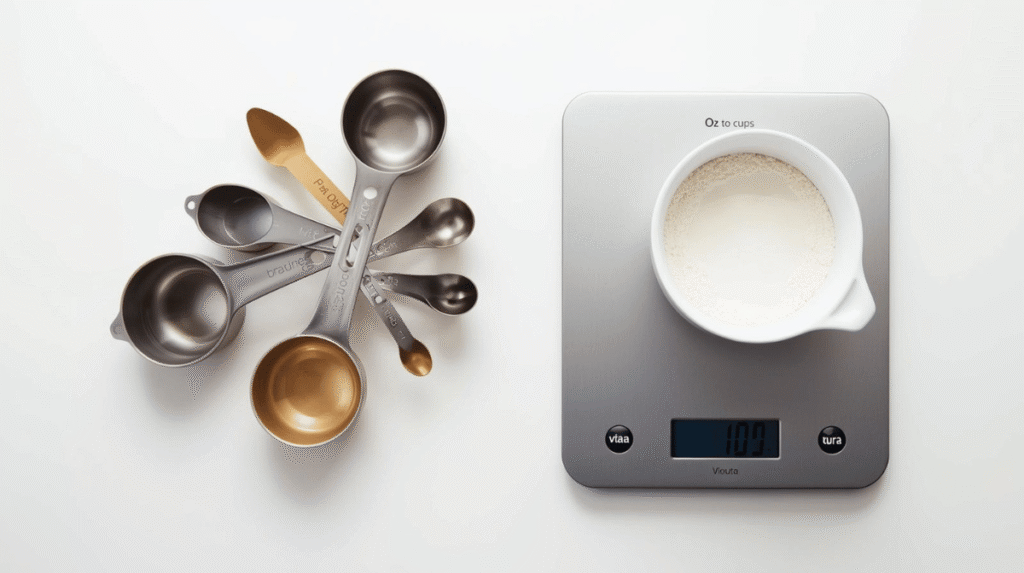
Ounces to Cups Converter – Easily Convert oz to Cups (Liquid & Dry)
Have you ever followed a recipe and wondered, “How many ounces are in a cup?” or “6 oz is how many cups?” Whether you’re baking a cake, cooking dinner, or measuring liquids, converting oz to cups correctly makes all the difference.
This article breaks down everything you need to know about ounces to cups conversion — including liquid ounces, dry ounces, and handy conversion tables for your kitchen.

Understanding Ounces vs. Cups
Before we jump into numbers, it’s important to know that ounces (oz) can mean two different things:
- Fluid ounces (fl oz) measure volume — used for liquids like milk or water.
- Dry ounces (oz) measure weight — used for solids like flour or sugar.
That means 8 oz of water is not always the same as 8 oz of flour. Using the SmartUnitCalculator Ounces to Cups Converter, you can convert either type accurately.
Related Calculator
Ounces to Cups & Metric Converter
Ounces to Cups & More Converter Cups Milliliters Liters Tablespoons Teaspoons Convert Convert ounces to cups, milliliters, liters, tablespoons, and…
Use This Calculator📁 More Miscellaneous Conversions Calculators
🔍 Explore All Miscellaneous Conversions CalculatorsHow Many Ounces Are in a Cup?
Let’s start with the basic conversion:
- 1 U.S. cup = 8 fluid ounces (fl oz)
- 1 fluid ounce = 1/8 cup
| Measurement | Cups | Fluid Ounces (fl oz) |
|---|---|---|
| 1 Cup | 1 | 8 fl oz |
| 1/2 Cup | 0.5 | 4 fl oz |
| 1/4 Cup | 0.25 | 2 fl oz |
| 3/4 Cup | 0.75 | 6 fl oz |
| 2 Cups | 2 | 16 fl oz |
So, when converting oz to cups:
- 8 oz = 1 cup
- 16 oz = 2 cups
- 4 oz = 1/2 cup
- 2 oz = 1/4 cup

Quick oz to Cups Conversion Chart
| Ounces (oz) | Cups | Equivalent |
|---|---|---|
| 1 oz | 0.125 cup | 2 tbsp |
| 2 oz | 0.25 cup | 1/4 cup |
| 3 oz | 0.375 cup | ~1/3 cup |
| 4 oz | 0.5 cup | 1/2 cup |
| 6 oz | 0.75 cup | 3/4 cup |
| 8 oz | 1 cup | 1 full cup |
| 10 oz | 1.25 cups | 1 1/4 cups |
| 12 oz | 1.5 cups | 1 1/2 cups |
| 16 oz | 2 cups | 1 pint |
| 32 oz | 4 cups | 1 quart |
Examples of Common Conversions
Let’s answer some of the most searched kitchen questions:
- 🧁 6 oz is how many cups? → 6 ÷ 8 = 0.75 cup (3/4 cup)
- ☕ 3 oz is how many cups? → 3 ÷ 8 = 0.375 cup (~1/3 cup)
- 🍶 8 oz to cups? → Exactly 1 cup
- 🍫 10 oz to cups? → 10 ÷ 8 = 1.25 cups (1 1/4 cups)
- 🍯 16 oz to cups? → 16 ÷ 8 = 2 cups
- 🥣 24 oz to cups? → 24 ÷ 8 = 3 cups
So, 6 oz equals 3/4 cup, and 4 oz equals 1/2 cup — easy to remember when baking or cooking!
Dry vs. Liquid Ounce to Cup Conversion
For liquids, conversions are straightforward. But for dry ingredients, density matters. For example:
| Ingredient | 1 Cup Equals | 1 Ounce Equals |
|---|---|---|
| All-purpose flour | 120g | 0.13 cups |
| Granulated sugar | 200g | 0.1 cups |
| Butter | 227g | 0.125 cups |
| Honey | 340g | 0.09 cups |
| Rice (uncooked) | 185g | 0.12 cups |
💡 Tip: Always check if your recipe uses weight ounces (oz) or fluid ounces (fl oz).
If you’re unsure, use the SmartUnitCalculator Ounces to Cups Converter — it calculates both types precisely.

Cups to Ounces Conversion
Sometimes you may need to reverse the calculation — from cups to oz.
| Cups | Ounces (fl oz) |
|---|---|
| 1/4 cup | 2 oz |
| 1/3 cup | 2.67 oz |
| 1/2 cup | 4 oz |
| 3/4 cup | 6 oz |
| 1 cup | 8 oz |
| 2 cups | 16 oz |
| 4 cups | 32 oz |
So if you’re wondering:
- How many ounces are in 3 cups? → 3 × 8 = 24 oz
- How many ounces are in 4 cups? → 4 × 8 = 32 oz
Practical Examples for Kitchen Use
Here are a few real-world examples of how to apply oz to cup conversions:
1. Measuring Ingredients
If your recipe calls for 6 oz of milk, that’s 3/4 cup.
If it needs 4 oz of butter, that’s 1/2 cup.
2. Adjusting Portions
When scaling a recipe, knowing cups to oz saves time.
For instance, doubling a recipe that calls for 8 oz of cream = 2 cups.
3. Metric Conversions
If you prefer metric, here are some quick references:
- 6 oz = 177 ml
- 8 oz = 237 ml
- 10 oz = 296 ml
- 16 oz = 473 ml
Common Conversion Questions
1️⃣ How many cups are in 8 oz?
8 oz equals 1 cup exactly.
2️⃣ How much is 4 oz in cups?
4 oz = 1/2 cup.
3️⃣ How many ounces in 3 cups?
3 × 8 = 24 ounces.
4️⃣ How many cups in 6 oz?
6 ÷ 8 = 0.75 cup (3/4 cup).
5️⃣ How many ounces are in 3/4 cup?
3/4 × 8 = 6 oz.
6️⃣ How many ounces in a cup of water?
A standard U.S. cup of water = 8 fluid ounces (237 ml).
Why Use the SmartUnitCalculator Ounces to Cups Converter
The Ounces to Cups Converter makes conversions simple and instant:
- 🔢 Converts oz to cups, cups to oz, and fl oz to cups
- 💧 Works for liquid and dry ingredients
- ⚡ Provides accurate metric equivalents (ml, g)
- 📱 Fully responsive for mobile and tablet users
No more guessing during cooking — get exact measurements every time.
Leaderboard (SUC)
Conclusion: Convert Ounces to Cups Like a Pro
Now you know exactly how to convert ounces to cups, cups to ounces, and even fl oz to cups in seconds. Whether it’s 6 oz of sugar, 10 oz of milk, or 16 oz of water, you’ll always have the perfect measurement.
FAQ’s
What’s the difference between “oz” and “fl oz”?
oz” usually refers to weight (mass) — commonly used for dry ingredients. “fl oz” (fluid ounce) refers to volume — used for liquids like water, milk, oil. Mixing them up can lead to inaccurate measurements.
How many fluid ounces are there in 1 US cup?
1 US cup equals 8 fluid ounces (fl oz).
Can I convert “oz” (weight) directly to cups?
Why do some recipes show different “cups” for the same ingredient?
Because “cups” can refer to different cup standards (US cup, Imperial cup, metric cup) — and because ingredients differ in density/compaction. Liquid ingredients should use fluid ounces; dry ingredients can vary in weight per cup depending on item and packing.
Is 1 cup always 8 oz?
Only when you mean 1 cup = 8 fluid ounces (for liquids). For weight (dry ingredients), 1 cup will not always equal 8 oz — it depends on the ingredient’s density.
What’s the conversion between tablespoons and fluid ounces / cups?
Can I use the converter for dry ingredients like flour or sugar?
What if the recipe uses a UK or Imperial cup instead of US cup?
Then conversion differs — US cup is 240 ml (8 fl oz), while Imperial and metric cups may vary in actual volume. Always check which cup standard the recipe uses.
Why do I get slightly different results using the converter vs my measuring cup?
Because real-world measuring tools (cups, spoons) vary slightly in size, and factors like liquid viscosity, ingredient density, and packing affect volume — especially with solids or dense liquids. The converter gives a standardized estimate; real cups may differ.
Is the converter accurate for all ingredients (water, oil, milk, flour, etc.)?
It’s perfectly accurate for liquids measured in fluid ounces (water, milk, oil, etc.). For solids or powders (flour, sugar, butter, etc.), it’s a rough estimate — use weight measurements for precise cooking or baking.
The Forge Calculator Roblox Guide: Best Strategy for Maximum Results
What Is The Forge in Roblox? The Forge is a crafting-focused Roblox game. Players mine…
How The Forge Calculator Works (Complete Guide)
What Is The Forge Calculator? The Forge Calculator is a fan-made online tool. It simulates…

Nanometers Explained: Measuring Molecules and Materials at the Nanoscale
The Direct Answer: What Is Nanometer ? A nanometer (symbol: nm) is a unit of…
Best Army Combinations in Settlers Combat Simulator (Winning Formulas)
1. Why Army Composition Matters More Than Army Size In The Settlers Online, a beginner looks…

What Is a Dalton? Understanding Atomic Mass in Chemistry
The Direct Answer: What Is a Dalton? A dalton (symbol: Da) is a unit of…

How Combat Simulators Help You Win Strategy Games (With Settlers Example)
1. The Hidden Cost of Guessing in Strategy Games You have been there. You spend…