
1. Introduction: Why Board Feet Matter in Spray Foam Projects
After working with contractors and homeowners on spray foam installations for over a decade, one issue appears more than any other: material miscalculation. Ordering too little foam stops the job halfway. Ordering too much inflates your budget unnecessarily.
That’s why understanding board foot calculations is essential. In fact, almost every major manufacturer—like Tiger Foam, Foam It Green, and Touch ’n Foam—prices their spray foam in board feet, not gallons or pounds.
A proper board foot estimate ensures:
- You won’t run out of product mid-project
- You’ll apply the correct thickness for the desired R-value
- You’ll avoid overspending on excess material
According to the U.S. Department of Energy (DOE), proper insulation thickness is critical to achieving expected energy savings—sometimes up to 20% annually. Therefore, getting board foot calculations right directly impacts performance and long-term efficiency.
Related Calculator
Spray Foam Insulation Cost Calculator
Spray Foam Insulation Cost Calculator | Estimate Your Project Spray Foam Insulation Cost Calculator Estimate your spray foam insulation project…
Use This Calculator📁 More Construction Calculators
🔍 Explore All Construction Calculators2. What Is a Board Foot? (Simple Definition)
A board foot is a standardized measurement used across the insulation and lumber industries.
Simple Definition:
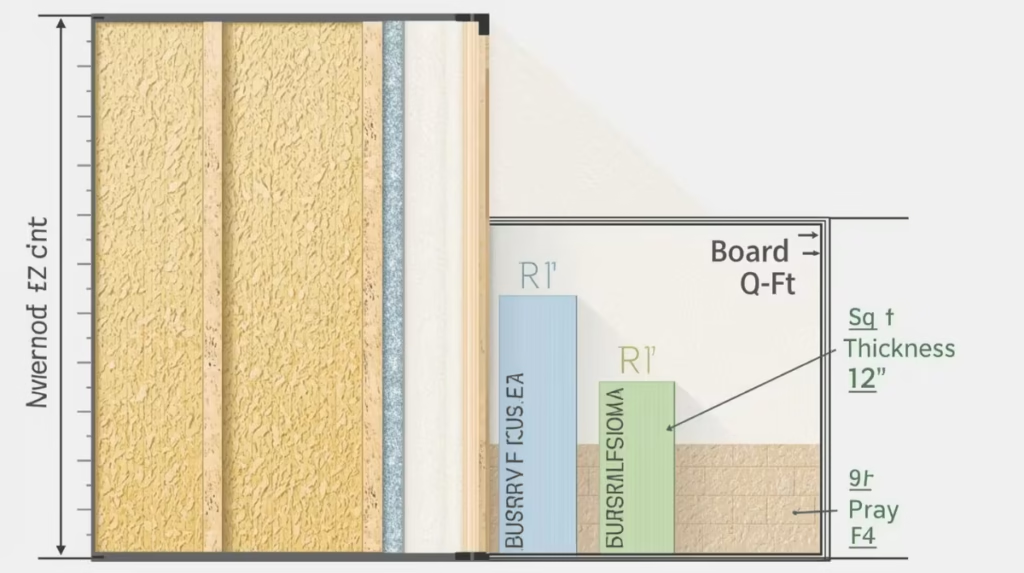
1 board foot = 12 inches × 12 inches × 1 inch thickness
This unit makes it easy to sell and estimate spray foam because:
- Foam expands
- Thickness varies
- Coverage depends on R-value requirements
Why Foam Is Sold This Way
Because both open-cell and closed-cell foam expand to different thicknesses, selling insulation by board foot creates a uniform metric for coverage.
Thickness Directly Affects Coverage
Example:
- A kit labeled 600 board feet will cover:
- 600 sq ft at 1 inch thick
- 300 sq ft at 2 inches thick
- 150 sq ft at 4 inches thick
3. How to Calculate Board Feet for Spray Foam (With Examples)
Here’s the formula almost every contractor uses:
Board Foot Formula:
Square Feet × Thickness (in inches) ÷ 12 = Board Feet Needed
Let’s walk through real examples:
Example 1: Attic Area
- Area: 500 sq ft
- Thickness: 2 inches
500 × 2 ÷ 12 = 83.33 board feet
Multiply by 10 or 12 for full-coverage kits depending on expansion.
Example 2: Garage Wall
- Area: 240 sq ft
- Thickness: 3 inches
240 × 3 ÷ 12 = 60 board feet
Coverage Chart (Quick Reference)
| Board Foot Kit Size | 1″ Coverage | 2″ Coverage | 3″ Coverage |
| 200 board feet | 200 sq ft | 100 sq ft | 66 sq ft |
| 600 board feet | 600 sq ft | 300 sq ft | 200 sq ft |
| 1200 board feet | 1200 sq ft | 600 sq ft | 400 sq ft |
This is why knowing board feet saves time and money—it makes purchasing accurate.
4. Closed Cell vs Open Cell: Board Foot Differences
Density
- Closed cell: ~2 lb density
- Open cell: ~0.5 lb density
R-Value
- Closed cell: R-6 to R-7 per inch
- Open cell: R-3.5 per inch
Closed cell requires fewer inches to reach the same R-value.
Cost per Board Foot
- Closed cell: $1.00–$1.50 per board foot
- Open cell: $0.45–$0.65 per board foot
Closed-cell foam costs more but performs significantly better for air sealing, moisture resistance, and structural strength.
5. Tools & Calculators for Board Foot Measurement
If you don’t want to calculate manually, use the tools that pros trust.
Top Online Board Foot Calculators
- SprayFoam.com Board Foot Calculator
Industry standard; widely used by contractors - Foam It Green Coverage Calculator
Great for DIY estimation - Tiger Foam Board Foot Tool
Provides kit recommendations - Home Depot R-Value & Coverage Estimator
Good for basic home projects - Energy.gov Insulation Estimator
Highly reliable and data-driven
Mobile Apps
- Construction Master Pro
- CalcPro
- Spray Foam Calculator Pro
Contractor Software
- JobNimbus
- AccuLynx
- BuilderTrend
These tools are accurate and reduce measurement mistakes significantly.
6. Common Mistakes to Avoid When Calculating Coverage
Even experienced installers make errors. Avoid these:
1. Not Converting Inches to Board Feet Correctly
Always divide thickness (in inches) by 12.
2. Underestimating Voids
Gaps, beams, and angled surfaces change actual square footage.
3. Ignoring Foam Expansion
Each foam brand expands differently—always check the manufacturer’s chart.
4. Assuming Both Foam Types Cover Equally
Open-cell expands more than closed-cell.
5. Forgetting Overspray Waste
Account for 10–15% extra material for most projects.
7. Final Tips for DIY and Professionals
When You Need a 200 Board Foot Kit
Best for:
- Small walls
- Rim joists
- Crawl space patches
- Single rooms
Choosing DIY Kits
Look for:
- Minimum 600 board foot kits for larger areas
- Kits with fan spray nozzles
- Temperature-controlled hoses
Use a Thickness Chart
Each manufacturer provides a recommended R-value thickness chart—for example:
- Closed cell: 2″ = R-12, 3″ = R-18
- Open cell: 3.5″ = R-13, 5.5″ = R-19
Thickness determines energy efficiency, comfort, and cost.
FAQs
1. How many board feet do I need for 1,000 sq ft?
At 1 inch thick: 1,000 board feet.
At 2 inches thick: 2,000 board feet.
2. Is closed-cell spray foam worth the extra cost?
Yes—its higher R-value and moisture resistance make it ideal for attics, basements, and garages.
3. Can I measure board feet without a calculator?
Yes—use the formula: sq ft × thickness ÷ 12.
4. What does a 600 board foot kit cover?
600 sq ft at 1 inch OR 300 sq ft at 2 inches.