
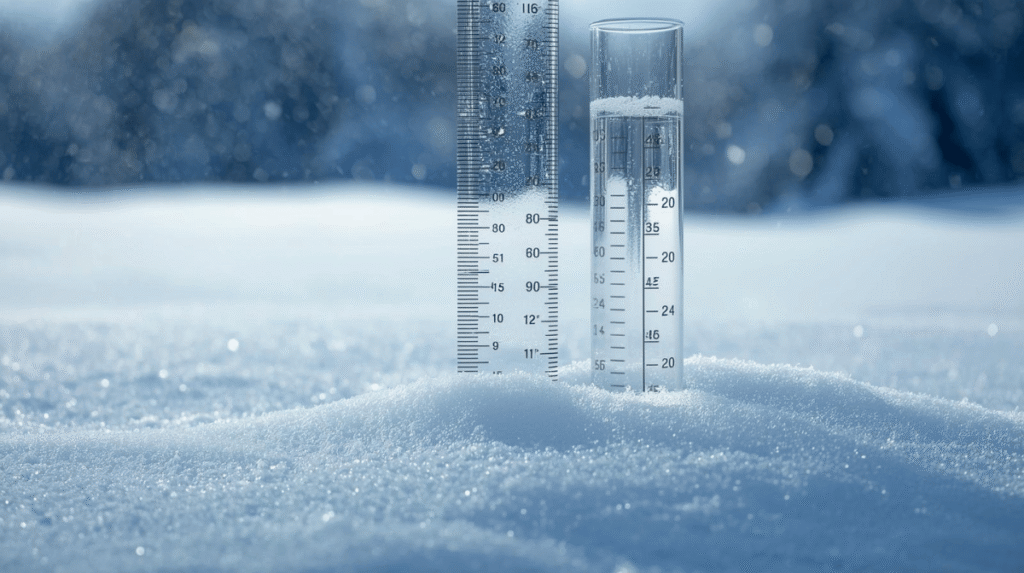
1. Introduction: A Common Winter Weather Question
After years of working with weather-related educational content and reviewing snowfall reports during winter storms, one question appears every season without fail:
“How much snow equals 1 inch of rain?”
Homeowners want to know if travel will be dangerous. Students want clarity for schoolwork. Contractors, farmers, and city planners need accurate estimates to prepare for snow removal and drainage.
Understanding snow measurement conversion isn’t just academic—it affects safety, planning, and daily decisions during winter weather.
2. The Simple Answer: 1 Inch of Rain = How Much Snow?
(Primary keyword: how much snow equals 1 inch of rain)
The most commonly used estimate is:
1 inch of rain ≈ 10 inches of snow
This is known as the 10:1 rule, meaning:
- 10 inches of snow contains about the same amount of water as 1 inch of rain
However—and this is critical—this is only an average.
According to the National Oceanic and Atmospheric Administration (NOAA), actual snowfall amounts can vary widely depending on temperature, snow type, and atmospheric conditions.
3. What Is the Rain-to-Snow Ratio?
(Primary keyword: rain to snow ratio)
The rain-to-snow ratio describes how many inches of snow result from 1 inch of liquid precipitation.
It answers the question:
“How fluffy or dense is the snow?”
Common ratios:
- 10:1 → Wet, heavy snow
- 15:1 → Average snow
- 20:1 to 30:1 → Dry, powdery snow
The higher the ratio, the lighter and fluffier the snow.
4. Why Snowfall Amounts Vary So Much
Snowfall depth depends on several factors:
🌡 Temperature
- Near freezing (32°F / 0°C): Wet, compact snow
- Below 20°F (-6°C): Light, fluffy snow
💧 Moisture Content
- Wet snow packs tightly
- Dry snow traps air, increasing depth
🌬 Wind & Compaction
- Wind redistributes snow
- Settling reduces depth over time
This is why two storms with the same rainfall amount can produce very different snowfall totals.
Related Calculator
Circumference to Diameter Calculator – Formula, Examples & Visual Guide
Circumference to Diameter Calculator Convert between circumference and diameter of a circle using the mathematical constant π (pi). Calculate: Circumference…
Use This Calculator📁 More Math Calculators
🔍 Explore All Math Calculators5. Rain-to-Snow Ratios Explained
(Semantic keyword: snow measurement conversion)
❄ 10:1 Ratio (Heavy Snow)
- 1 inch rain = 10 inches snow
- Common in warmer winter storms
- Harder to shovel, heavier on roofs
❄ 15:1 Ratio (Average Snow)
- 1 inch rain = 15 inches snow
- Typical cold-weather snowfall
❄ 20:1+ Ratio (Powder Snow)
- 1 inch rain = 20–30 inches snow
- Found in very cold, dry air
- Lighter but causes drifting
Meteorologists at The Weather Channel regularly adjust snowfall forecasts using these ratios instead of relying on a fixed number.
6. Real-World Examples by Temperature
Let’s look at practical scenarios:
Example 1: Wet Snowstorm (30°F / -1°C)
- Rainfall equivalent: 1 inch
- Snow ratio: 10:1
- Expected snowfall: 10 inches
Example 2: Cold Winter Storm (20°F / -6°C)
- Rainfall equivalent: 1 inch
- Snow ratio: 15:1
- Expected snowfall: 15 inches
Example 3: Arctic Air Mass (10°F / -12°C)
- Rainfall equivalent: 1 inch
- Snow ratio: 25:1
- Expected snowfall: 25 inches
These examples show why a rain-to-snow calculator is far more reliable than guessing.
7. How Meteorologists Measure Snowfall
Snowfall is measured using:
- Flat snow boards
- Rulers or calibrated sticks
- Multiple readings averaged over time
The National Weather Service (NWS) recommends measuring snow before it melts or compacts, which helps improve forecast accuracy.
This careful process highlights why accurate snow measurement conversion matters.
8. Why Using a Snow Measurement Conversion Tool Helps
Manual estimates often fail because:
- People assume 10:1 every time
- Conditions change mid-storm
- Snow compacts quickly
A dedicated converter:
- Adjusts for different ratios
- Converts rain to snow instantly
- Reduces planning errors
This is especially useful for:
- Homeowners
- Snow removal services
- Emergency planners
- Students and educators
9. Conclusion: Know the Snow Before the Storm
So, how much snow equals 1 inch of rain?
Usually 10 inches—but sometimes much more.
Understanding rain-to-snow ratios helps you:
- Prepare for travel disruptions
- Estimate snow loads
- Make safer winter decisions
📌 Best advice: Learn the basics, then rely on a reliable conversion tool for real-world accuracy.
10. FAQs
1. Is 10 inches of snow always equal to 1 inch of rain?
No. It’s an average—actual snowfall can range from 5 to 30 inches.
2. Why does cold weather produce more snow?
Colder air creates drier, fluffier snow with higher ratios.
3. Does snowfall melt into the same amount of rain?
Eventually yes, but compaction and evaporation affect results.
4. What is the most accurate snow ratio?
There isn’t one—meteorologists adjust ratios based on conditions.
5. Should I use a rain-to-snow calculator?
Yes, especiallya for planning, safety, or education.

The Forge Calculator Roblox Guide: Best Strategy for Maximum Results
What Is The Forge in Roblox? The Forge is a crafting-focused Roblox game. Players mine…
How The Forge Calculator Works (Complete Guide)
What Is The Forge Calculator? The Forge Calculator is a fan-made online tool. It simulates…

Nanometers Explained: Measuring Molecules and Materials at the Nanoscale
The Direct Answer: What Is Nanometer ? A nanometer (symbol: nm) is a unit of…
Best Army Combinations in Settlers Combat Simulator (Winning Formulas)
1. Why Army Composition Matters More Than Army Size In The Settlers Online, a beginner looks…

What Is a Dalton? Understanding Atomic Mass in Chemistry
The Direct Answer: What Is a Dalton? A dalton (symbol: Da) is a unit of…

How Combat Simulators Help You Win Strategy Games (With Settlers Example)
1. The Hidden Cost of Guessing in Strategy Games You have been there. You spend…