
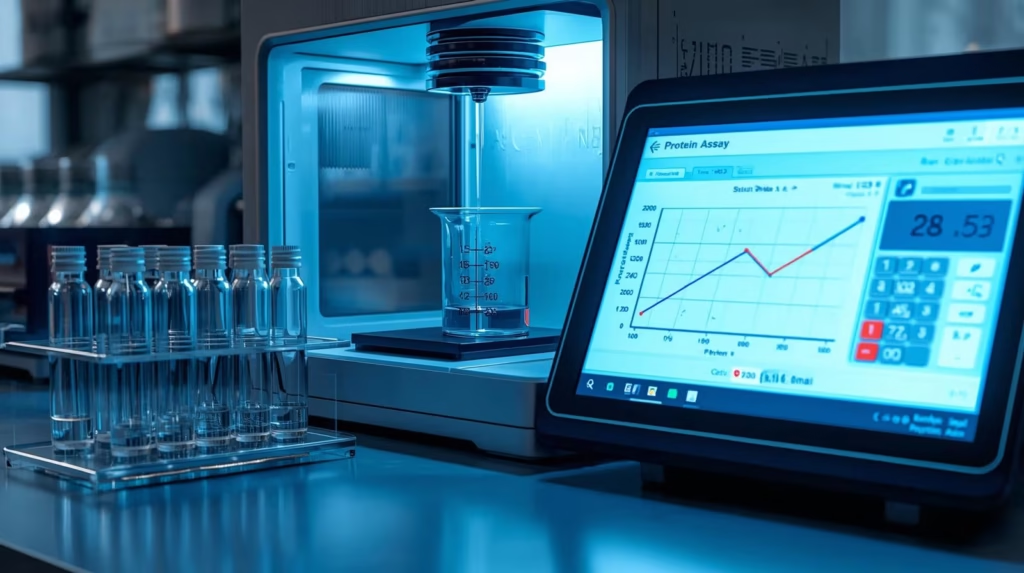
Working in a biology or biochemistry lab often means dealing with protein. Whether you’re preparing samples for Western blot, setting up an ELISA, or performing enzyme kinetics, determining the amount of protein in your sample is crucial. Yet, the array of protein concentration units like µg/mL, mg/L, or even molar concentrations can feel like a foreign language. This confusion sometimes leads to errors, delays, and wasted reagents. That’s why I’m here to demystify these units and show you how our lab protein concentration calculator simplifies the entire process.
Why Understanding Protein Concentration Units Matters
Accurate protein concentration is more than just a number; it’s the bedrock of reliable scientific experiments. Without it, your carefully constructed hypotheses and experimental setups can crumble. Precision in these measurements ensures your results are comparable and meaningful.
The Importance of Precision in Biology
In biological research, even small discrepancies in protein concentration can significantly alter experimental outcomes. For instance, using too much or too little protein in an assay can lead to false positives or negatives, compromising data reliability. This precision is vital for everything from drug discovery to understanding fundamental cellular processes, directly impacting experimental reproducibility.
Common Scenarios Requiring Conversion
You’ll encounter unit conversions constantly in the lab. Imagine synthesizing a new peptide that is quantified in milligrams per liter, but your downstream assay requires it to be at a specific microgram per milliliter concentration. Or perhaps you’re comparing your experimental yield to published data, which might use entirely different units. Knowing how to convert protein concentration quickly and accurately becomes an indispensable skill.
Decoding Common Protein Concentration Units
Let’s break down the most frequently used protein concentration units. Understanding what each unit represents is the first step towards mastering protein quantification.
Micrograms per Milliliter (µg/mL) Explained
Micrograms per milliliter (µg/mL) is one of the most common units for protein concentration. It represents the mass of protein (in micrograms) present in each milliliter of solution. This unit is widely used because it typically falls within the concentration ranges encountered in many biological assays. For example, a Bradford assay often quantifies protein in this range, making µg/mL standard for reporting sample concentrations.
Milligrams per Liter (mg/L) Explained
Milligrams per liter (mg/L) specifies the mass of protein (in milligrams) per liter of solution. This unit is often used for larger volumes or when dealing with slightly higher concentrations. Importantly, 1 µg/mL is exactly equivalent to 1 mg/L. This one-to-one conversion is a frequent source of confusion but makes conversions between these two units straightforward. Knowing this equivalence is a significant step in understanding protein concentration units explained.
Other Relevant Units: mg/mL, M, mM, µM
While µg/mL and mg/L are prevalent, other units serve specific purposes:
- Milligrams per Milliliter (mg/mL): This unit indicates milligrams of protein per milliliter of solution. It’s used for more concentrated protein samples, such as purified protein stocks. Converting µg/mL to mg/mL involves dividing by 1000.
- Molar Concentration (M, mM, µM): Molarity (moles per liter) is crucial when protein size or specific molecular interactions matter. A mole represents 6.022 x 10²³ molecules.
- M (molar): Moles per liter. Used for very high concentrations or reagents.
- mM (millimolar): Millimoles per liter (10-3 M).
- µM (micromolar): Micromoles per liter (10-6 M).
To convert between mass units (like µg/mL) and molar units (like µM), you need the protein’s molecular weight. This conversion is essential for experiments studying protein-ligand binding or enzyme kinetics, which depend on the number of protein molecules.
The Basics of Converting Protein Concentration Units
Understanding how to manually convert protein concentration units equips you with fundamental lab skills, even when you have a calculator handy.
Manual Conversion Formulas and Examples
Conversions often rely on simple metric prefixes. Remember these key relationships:
- 1 milligram (mg) = 1000 micrograms (µg)
- 1 liter (L) = 1000 milliliters (mL)
Let’s look at some practical examples:
- Converting µg/mL to mg/L:
Since 1 µg = 1/1000 mg and 1 mL = 1/1000 L, these two factors cancel out.
So, 1 µg/mL = 1 mg/L.Example: If you have 50 µg/mL protein, it’s also 50 mg/L.
- Converting µg/mL to mg/mL:
You need to convert micrograms to milligrams while keeping the volume unit the same.
Divide µg by 1000.
Formula: mg/mL = µg/mL / 1000Example: If you have a concentration of 200 µg/mL, what is it in mg/mL?
200 µg/mL ÷ 1000 = 0.2 mg/mL
These step-by-step calculations help illustrate the logic behind conversions. While manual conversion can be tedious, it solidifies your understanding of how units relate.
When To Convert: Practical Applications
Knowing when to convert protein concentration is as important as knowing how. Here are some scenarios:
- Preparing Stock Solutions: You might purchase a protein standard at 1 mg/mL but need to use it at a working concentration of 10 µg/mL.
- Normalizing Samples: Often, you need to load an equal amount of protein onto a gel or into an assay well. This requires converting all sample concentrations to a common unit and then diluting or concentrating them appropriately.
- Data Comparison: When comparing your lab’s results (e.g., protein yield from a purification) with published literature, you’ll frequently convert units to match. This ensures a direct and accurate comparison.
These practical applications underscore the importance of unit conversion for accurate protein quantification.
Mastering Protein Quantification in the Lab
Accurate protein quantification is a cornerstone of success in many scientific disciplines. Beyond unit conversions, several factors influence the reliability of your measurements.
Key Factors Affecting Accuracy
For improving protein assay results, consider these points:
- Sample Purity: Contaminants can interfere with colorimetric assays, leading to overestimation. Highly pure samples yield more accurate readings.
- Assay Choice: Different assays (Bradford, BCA, Lowry) have varying sensitivities and reactivities to different protein types and buffer components. Choose an assay compatible with your sample and experimental goals.
- Standard Curve Quality: A precise standard curve, generated with known concentrations of a similar protein, is critical. Ensure your unknown samples fall within the linear range of this curve.
- Pipetting Technique: Poor pipetting is a common source of error. Always use calibrated pipettes and consistent technique.
Tips for Improving Your Protein Assay Results
Beyond understanding the units, these tips will significantly help in improving protein assay results:
- Use Fresh Reagents: Always prepare fresh assay reagents according to manufacturer instructions. Old reagents can degrade and lead to inaccurate readings.
- Run Technical Replicates: Measure each sample multiple times (e.g., in triplicate). This helps identify and account for pipetting errors or assay variability.
- Optimize Incubation Times and Temperatures: Ensure your assay follows recommended incubation conditions strictly, as these affect color development and signal intensity.
- Blank Correct Carefully: Always use an appropriate blank (e.g., buffer without protein) to zero your spectrophotometer, subtracting any background absorbance.
Common Mistakes to Avoid
Even experienced researchers can fall into these traps:
- Outdated Standard Curve: Never reuse a standard curve from a previous day. Always generate a fresh one alongside your samples.
- Incorrect Dilutions: Miscalculating dilutions or performing them inaccurately will propagate errors through your entire experiment. Double-check all dilution calculations.
- Ignoring Buffer Effects: Some buffers or detergents can interfere with specific protein assays. Be aware of potential interferences and choose an assay accordingly.
- Not Mixing Thoroughly: Ensure all components are thoroughly mixed at each step to guarantee uniform reactions.
Simplify Conversions with Our Protein Concentration Calculator
While understanding manual conversions is important, doing them repeatedly can be time-consuming and prone to human error. Our dedicated protein concentration calculator is designed to be your reliable lab assistant. It swiftly converts between µg/mL, mg/L, mg/mL, and even molar concentrations, eliminating calculation mistakes. This tool not only saves precious lab time but also significantly boosts confidence in your data, allowing you to focus on the science rather than the arithmetic. Use our protein concentration calculator for instant, error-free conversions and ensure your results are always accurate.
Conclusion: Achieving Accurate and Reproducible Results
Mastering protein concentration units and their conversions is fundamental for any successful biological experiment. By understanding the nuances of µg/mL, mg/L, and other units, you lay the groundwork for precise and reproducible results. While manual calculations offer valuable insight, our lab protein concentration calculator provides an indispensable tool for speed and accuracy. Empower your research by ensuring every protein measurement is spot-on.
Frequently Asked Questions
What is the most common unit for protein concentration?
The most common unit for protein concentration in many biological laboratories is micrograms per milliliter (µg/mL) because it typically aligns with the concentrations used in common assays, such as Bradford assays.
Are µg/mL and mg/L the same?
Yes, 1 µg/mL is exactly equivalent to 1 mg/L. This is a common conversion based on metric prefixes: 1 microgram (µg) is 1/1000 of a milligram (mg), and 1 milliliter (mL) is 1/1000 of a liter (L), so the factors cancel out.
Why do I need to convert protein concentration units?
You need to convert protein concentration units to prepare reagents correctly, normalize samples for experiments, or compare your experimental data with results published using different units. Accurate conversion ensures experimental reproducibility and data reliability.
When would I use molar concentration (M, mM, µM) for protein?
Molar concentration is used when the number of protein molecules defines an interaction, such as in enzyme kinetics studies, ligand binding experiments, or when calculating specific molecular ratios. It requires knowing the protein’s molecular weight.
What factors affect the accuracy of protein quantification?
Key factors affecting accuracy include sample purity, the choice of protein assay (e.g., Bradford, BCA), the quality of your standard curve, proper pipetting technique, and potential interferences from buffer components.
How can a protein concentration calculator help me?
A protein concentration calculator saves time by performing conversions instantly, reduces the chance of manual calculation errors, and allows you to quickly adjust concentrations for various experimental requirements, thereby improving protein assay results and reliability.