
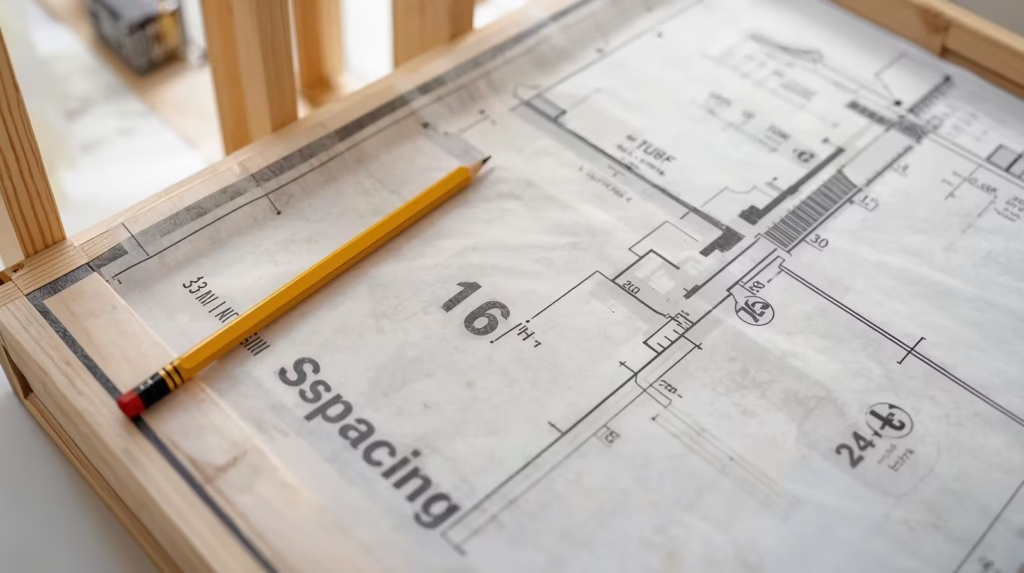
Understanding Wall Stud Spacing: Why It Matters
As someone who’s spent years around construction sites, from framing new homes to renovating older structures, I can tell you that the seemingly small details often make the biggest difference. One such detail, critical yet often overlooked by beginners, is wall stud spacing. It’s not just about nailing boards together; it’s about creating a sturdy, safe, and efficient structure.
The spacing of your wall studs directly impacts a wall’s strength, insulation efficiency, and how easily you can attach interior and exterior finishes. Choosing the correct stud spacing, typically either 16 inches or 24 inches on-center (O.C.), for your project is fundamental. This guide will walk you through everything you need to know about wall stud spacing, helping you make informed decisions for your next building or renovation.
What Does “On-Center” (O.C.) Mean?
Before diving into specific spacing options, let’s clarify “on-center” (O.C.). This term refers to the measurement from the dead center of one stud to the dead center of the next stud. It’s a standard measurement in framing because it helps ensure uniform spacing and simplifies the installation of sheathing and drywall, which come in standard sizes.
For example, if you place your first stud at 0 inches, a 16-inch O.C. spacing means the next stud’s center will be at 16 inches, the following at 32 inches, and so on. This consistent measurement is crucial for proper alignment when covering the studs with building materials.
16-Inch On-Center Stud Spacing
16-inch O.C. has long been the traditional standard for residential construction in many regions. It involves placing the center of each wall stud 16 inches from the center of the previous stud.
Advantages of 16-Inch O.C.
- Increased Wall Strength: Closer stud placement means more support for the wall, making it inherently stronger. This is particularly beneficial for load-bearing walls or in areas prone to high winds or seismic activity.
- Easier Drywall and Sheathing Installation: Standard drywall sheets (4×8 feet) and plywood/OSB sheathing align perfectly with 16-inch O.C. spacing. You can typically nail each edge of a 4-foot wide sheet into a stud.
- Better Support for Finishes: More studs provide more attachment points for cabinets, shelving, and other wall-mounted fixtures. This reduces sagging or cracking of finishes over time.
- Familiarity: Most tradespeople are very familiar with this spacing, which can streamline the construction process and minimize errors.
Disadvantages of 16-Inch O.C.
- Higher Material Costs: More studs are required for the same wall length, leading to higher lumber expenses.
- More Labor Intensive: Cutting and installing more studs adds to the labor time for framing.
- Reduced Insulation Space: The closer studs mean more wood in the wall cavity, slightly reducing the available space for insulation. This can lead to more “thermal bridging,” where heat escapes through the wood.
24-Inch On-Center Stud Spacing
24-inch O.C. spacing is gaining popularity, especially in non-load-bearing walls and for “green” building practices. It means placing the center of each stud 24 inches from the center of the previous one.
Advantages of 24-Inch O.C.
- Lower Material Costs: Significantly fewer studs are needed, resulting in substantial savings on lumber.
- Reduced Labor: Less cutting and nailing means faster framing times and lower labor costs.
- Improved Energy Efficiency: More space between studs allows for thicker and more continuous insulation. This reduces thermal bridging and can lead to better overall energy performance of the buildingEnvelope.
- Sustainable Approach: Using less lumber is a more environmentally friendly construction practice.
Disadvantages of 24-Inch O.C.
- Reduced Wall Strength: Walls framed with 24-inch O.C. are generally less rigid than those with 16-inch O.C. They might feel “flexier” and require thicker drywall (e.g., 5/8-inch instead of 1/2-inch) to prevent sagging.
- Attachment Challenges: Finding studs to hang heavy items like televisions or heavy shelving units can be more challenging due to the wider spacing.
- Drywall Sagging Risk: If not properly installed or if using thin drywall, visible sagging or “pillowing” between studs can occur.
- Building Code Restrictions: Some local building codes might have limitations on using 24-inch O.C. for certain wall types or building sizes. Always check local requirements.
Choosing the Right Wall Stud Spacing for Your Project
Deciding between 16-inch and 24-inch O.C. isn’t a one-size-fits-all answer. It depends heavily on the specific requirements of your project.
Key Factors to Consider
- Wall Function: Is it a load-bearing wall supporting upper floors or the roof? If so, 16-inch O.C. or even narrower spacing might be necessary for structural integrity. For non-load-bearing partition walls, 24-inch O.C. is often suitable.
- Material Costs: If budget is a primary concern, 24-inch O.C. offers significant lumber savings. You can quickly estimate the number of studs needed with our Wall Stud Calculator.
- Drywall Thickness: For 24-inch O.C. spacing, using 5/8-inch drywall is often recommended to prevent sagging compared to standard 1/2-inch drywall.
- Desired Wall Finish: If you plan to hang heavy objects, cabinets, or tiled surfaces, the extra support of 16-inch O.C. can be advantageous.
- Insulation Needs: If energy efficiency is a high priority and you need maximum insulation, 24-inch O.C. creates more space for insulating materials.
Building Codes and Regional Requirements
No matter your preference, your local building codes are the ultimate authority. These codes dictate minimum requirements for structural components, including wall stud spacing, based on factors like zone, anticipated loads, and overall wall construction. Always consult your local planning department or a qualified engineer before beginning any structural work.
Optimization Tips for Efficient Wall Framing
Beyond the 16-inch vs. 24-inch O.C. decision, several strategies can help you optimize studs and improve your framing process.
Consider Sheathing and Drywall Sheet Sizing
Standard sheets of plywood, OSB, and drywall are typically 4 feet wide (48 inches). This dimension pairs exceptionally well with both 16-inch (3×16=48) and 24-inch (2×24=48) O.C. spacing. Planning your framing layout to ensure sheet edges land squarely on the center of a stud will minimize waste and speed up installation. Don’t forget to calculate material costs carefully.
Load-Bearing vs. Non-Load-Bearing Walls
Treat these differently. Load-bearing walls require careful attention to structural integrity. While 16-inch O.C. is common, engineers might specify closer spacing or larger studs (e.g., 2×6 instead of 2×4) in some cases. For interior, non-load-bearing walls, 24-inch O.C. is often perfectly acceptable and more economical.
Window and Door Openings
These openings interrupt regular stud spacing. Plan for them during initial layout. You’ll need cripple studs, jack studs, king studs, and headers to frame these openings properly. This also influences how you start your stud layout, often beginning from one end of the wall or from the center of a significant opening.
Advanced Framing Techniques
Sometimes called “optimum value engineering” (OVE), advanced framing techniques aim to reduce lumber use while maintaining structural integrity. This includes:
- Two-stud corners: Instead of three or four studs, reducing thermal bridging.
- Single top plates: In some cases, rather than double top plates, with proper engineering.
- In-line framing: Aligning floor joists, wall studs, and roof trusses to create a continuous load path, which often uses 24-inch O.C. spacing.
These techniques further help to optimize studs and improve overall energy efficiency. You can often find additional handy tools on our page for construction calculators.
Frequently Asked Questions
Is 24-inch O.C. safe for exterior walls?
Yes, 24-inch O.C. can be safe for exterior walls, but it depends heavily on local building codes, structural loads, and whether it’s engineered for your specific climate zone (e.g., high wind or seismic areas). Thicker sheathing and specific fastening schedules are often required to ensure stability.
Can I mix 16-inch and 24-inch O.C. spacing in the same house?
Absolutely. It’s common to use 16-inch O.C. for load-bearing walls and exterior walls where greater rigidity is desired, and 24-inch O.C. for interior, non-load-bearing partition walls to save on materials and labor.
Does stud spacing affect soundproofing?
Indirectly, yes. Walls with wider stud spacing (24-inch O.C.) create larger cavities, which can offer more space for sound-dampening insulation. However, sound transmission is complex and also depends on drywall thickness, type of insulation, and sealing techniques.
What is the maximum span for studs?
The maximum span for studs depends on many factors: stud size (e.g., 2×4, 2×6), wood species and grade, ceiling height, and whether the wall is load-bearing. Always consult a span table from your local building code or seek professional engineering advice, but typically 2×4 studs at 16-inch O.C. are limited to 10-foot ceilings for load-bearing and 12-foot for non-load-bearing when considering standard practices.
How do I find studs in an existing wall?
You can find studs using an electronic stud finder, by looking for nail pops or outlets (which are usually attached to studs), or by tapping on the wall and listening for a solid sound versus a hollow one. Studs are typically spaced 16 or 24 inches O.C. from a corner.
Final Thoughts on Wall Stud Spacing
The choice between 16-inch O.C. and 24-inch O.C. wall stud spacing is a fundamental decision impacting structural integrity, cost, labor, and energy efficiency. While 16-inch O.C. provides robust strength, 24-inch O.C. offers material and energy savings. Always weigh these factors against your project’s specific needs and, crucially, understand and adhere to your local building codes.
For estimating materials for your next project, remember to utilize our Wall Stud Calculator. This tool simplifies planning and allows you to make precise decisions, helping you achieve durable and efficient results.