
1. The Hidden Cost of Guessing in Strategy Games
You have been there. You spend an hour gathering resources, training troops, and marching across the map. You attack an enemy camp with confidence because you have more units. Then, disaster. Your army is annihilated. The enemy still stands. You have nothing left.
This is the hidden cost of guessing in games like The Settlers Online, Total War, Age of Empires, and StarCraft. You cannot win by intuition alone because modern strategy games have complex combat math under the hood.
The problem is not your skill. The problem is incomplete information.
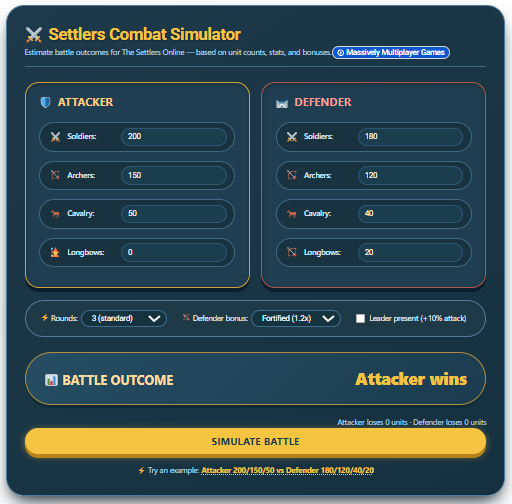
You know your army composition. But do you know exactly how your 200 soldiers will perform against 180 soldiers backed by 120 archers, 40 cavalry, and 20 longbows? Oh, and the defender is in a fortified position with a 20% defense bonus.
Without a tool, you have two options:
- Attack blindly and risk total loss.
- Over-build conservatively and waste resources on troops you do not need.
A combat simulator gives you a third option: knowing the outcome before you attack.
2. What Is a Combat Simulator? (Beyond Simple Math)
A combat simulator is a software tool that models a game’s battle mechanics. You input army compositions (unit types and counts), optional conditions (terrain, fortifications, leader bonuses), and the simulator runs thousands of virtual battles to predict the most likely outcome.
It is not a simple calculator that just compares total army strength. That would be useless. A good simulator accounts for:
- Unit counters: Pikemen beat cavalry, but archers beat pikemen.
- Attack and defense values: Not all soldiers are equal.
- Damage calculation: How much damage does each unit deal per hit?
- Health and armor: How many hits can a unit survive?
- Round-based combat: Units attack simultaneously each round.
- Randomization: Critical hits, misses, and morale breaks.
The simulator aggregates all of this complexity into three simple answers:
- Who wins? (Attacker, Defender, or Draw)
- How many units survive on each side?
- Was the victory worth the cost?
Real-world analogy: A combat simulator is to strategy games what a poker odds calculator is to poker. It does not guarantee a win, but it prevents you from going all-in with a losing hand.
3. Why Every Strategy Gamer Needs a Battle Calculator
Here are five concrete reasons to use a combat simulator before every major battle.
Reason 1: Save Hours of Rebuilding Time
In The Settlers Online, training 100 cavalry might take 2 real-time hours and consume resources from five different production chains. Losing them in a bad fight means 2 hours of waiting and re-gathering resources.
A simulator takes 30 seconds. For 30 seconds of your time, you avoid 2 hours of rebuilding. That is a 240x return on investment.
Reason 2: Learn the Counter System Without Painful Losses
You could learn that archers beat pikemen by losing an army of pikemen to archers. Or you could learn it by running five simulations in two minutes. One method costs you hours. The other costs you nothing.
Simulators are the fastest way to internalize a game’s rock-paper-scissors balance.
Reason 3: Find the Minimal Winning Army
This is the advanced skill that separates good players from great players. A beginner asks: “Can I win?” A great player asks: “What is the smallest, cheapest army that still wins reliably?”
By iterating in the simulator (starting with a small army and slowly increasing), you find the minimal resource cost for victory. This preserves your economy for multiple attacks.
Reason 4: Test “What If” Scenarios Safely
- “What if I send only archers and no infantry?”
- “What if I attack from two directions?” (You can approximate this by giving the attacker a morale bonus.)
- “What if the defender has a 50% fortification bonus instead of 20%?”
In the real game, testing these scenarios means losing real armies. In a simulator, you can run 50 experiments in five minutes.
Reason 5: Build Confidence for Multiplayer
Anxiety before a PvP battle is real. You hesitate. You second-guess. You make mistakes.
Running a simulation beforehand replaces uncertainty with data. “The simulator says I have an 85% win probability with this exact army. I trust the math.” That confidence translates to cleaner execution.
4. Deep Dive: How the Settlers Combat Simulator Works
Now let us look specifically at your Settlers Combat Simulator tool and the mechanics it models.
Unit Types in Your Tool
Your simulator currently includes four unit types, each with distinct roles:
| Unit | Role | Strong Against | Weak Against |
|---|---|---|---|
| Soldiers (⚔️) | Balanced melee | Archers, Longbows | Cavalry (in some games) |
| Archers (🏹) | Ranged DPS | Pikemen, slow units | Cavalry (fast closing) |
| Cavalry (🐎) | Shock, flanking | Archers, Longbows | Pikemen, fortified positions |
| Longbows (🧙) | Elite ranged | Most infantry | Cavalry, heavy armor |
Note: Your tool currently labels Longbows with a 🧙 icon. You may want to change this to 🏹 for clarity or add a note explaining the icon.
Core Mechanics Modeled
Your simulator uses a round-based, simultaneous damage model:
- Round start: All living units on both sides are present.
- Damage calculation: Each unit deals damage to an enemy unit (based on attack value vs. target defense).
- Damage application: Damage is applied simultaneously. Units whose accumulated damage exceeds their health are removed.
- Next round: Repeat until one side has no units remaining or the maximum round limit is reached.
Bonuses your simulator includes:
- Defender fortification bonus: 1.2x or 1.5x multiplier to defender’s effective strength. This models walls, towers, and defensive terrain.
- Leader bonus: +10% attack for the side with a general or hero present.
- Maximum rounds: Stops simulation after a set number of rounds (avoids infinite stalemates with healers).
What Your Simulator Does NOT Yet Model (And That Is Fine)
For simplicity and speed, your current tool aggregates unit types rather than simulating individual units. This is a reasonable trade-off for a free, fast web tool. Advanced simulators might also include:
- Individual unit health tracking
- Random critical hits
- Morale and routing
- Flanking position bonuses
- Unit experience levels
However, for 95% of The Settlers Online battles, your simplified model is accurate enough to make better decisions.
Settlers Combat Simulator Calculator
5. Step-by-Step: Planning an Attack with the Settlers Tool
Let us walk through a real planning session using your tool.
Scenario
You are playing The Settlers Online. You have scouted an enemy camp and see:
- Defender: 180 Soldiers, 120 Archers, 40 Cavalry, 20 Longbows
- Defender bonus: Fortified camp (1.2x bonus)
- Your available army: 250 Soldiers, 150 Archers, 80 Cavalry, 0 Longbows
Step 1: Enter Your Army (Attacker)
- Soldiers: 250
- Archers: 150
- Cavalry: 80
- Longbows: 0
Step 2: Enter Enemy Army (Defender)
- Soldiers: 180
- Archers: 120
- Cavalry: 40
- Longbows: 20
Step 3: Set Battle Options
- Defender bonus: 1.2x (fortified)
- Leader bonus: None for this example (no general on either side)
- Maximum rounds: 20 (default)
Step 4: Click “Simulate Battle”
Example result (will vary slightly due to randomization in your algorithm):
- Attacker loses: 210 units
- Defender loses: All 360 units
- Winner: Attacker (narrow victory)
Step 5: Interpret the Result
You win, but you lose 210 out of 480 units (44% casualties). Is this worth it?
Ask yourself:
- Can you afford to replace 210 units right now?
- Is this camp blocking your main objective, or can you go around?
- Do you have time to train more cavalry to reduce casualties?
Step 6: Iterate in the Simulator
Run a second simulation with a different composition:
- New attacker: 200 Soldiers, 150 Archers, 130 Cavalry (same total 480 units, but more cavalry)
New result:
- Attacker loses: 175 units (35 casualties, improved!)
Run a third simulation:
- New attacker: 180 Soldiers, 140 Archers, 160 Cavalry
New result:
- Attacker loses: 155 units (32% casualties)
By spending 5 minutes in the simulator, you have reduced expected casualties from 210 to 155 – saving you 55 units worth of resources and training time.
6. Real Example: Turning a Certain Loss into a Narrow Victory
Here is a dramatic example based on actual Settlers Online forum posts.
The Situation
A player has 300 Soldiers and sees an enemy camp with 150 Soldiers + 200 Archers (no fortification). The player assumes, “I have more total units, so I will win.”
Simulation result (using your tool):
- Attacker: 300 Soldiers
- Defender: 150 Soldiers, 200 Archers
- Result: Defender wins. Attacker loses all 300. Defender loses only 120 Soldiers.
Why? The 200 enemy archers deal ranged damage while the attacker’s soldiers slowly close the distance. By the time the soldiers reach melee, half are dead.
The Fix
The player runs a second simulation:
- Attacker: 150 Soldiers + 150 Cavalry
- Result: Attacker wins with 80 survivors.
Why this works: Cavalry closes distance faster than soldiers, taking fewer archer shots. Once cavalry engages the archers in melee, the archers are neutralized.
Lesson: More units does not always mean victory. The right composition beats a larger but poorly chosen army.
7. Beyond Settlers: Applying Simulators to Other Games
The principles you learn from the Settlers Combat Simulator apply to many other strategy games.
| Game | What to Simulate | Benefit |
|---|---|---|
| Total War series | Unit matchups, flanking, terrain | Minimize casualties in auto-resolve battles |
| Age of Empires IV | Counter units, upgrade impacts | Optimize army composition for your economy |
| StarCraft II | Timing attacks, unit counters | Find the minimal force for a successful rush |
| Civilization VI | Tech advantages, terrain bonuses | Decide whether to declare war |
| Mount & Blade II | Troop tiers, weapon types | Plan garrisons and field armies |
Key takeaway: Any game with deterministic or semi-deterministic combat math can benefit from a simulator. The tool removes guesswork and replaces it with data.
8. Common Mistakes When Using Combat Simulators
Even with a great tool, players make errors. Avoid these.
Mistake #1: Assuming 100% Accuracy
No simulator perfectly replicates in-game randomness, player skill, or unexpected variables (lag, misclicks, third-party interference).
Fix: Treat anything above 80% win probability as “likely win.” Above 90% as “very likely.” Never assume 100%.
Mistake #2: Forgetting to Scout First
A simulator is only as good as the data you input. If you guess the enemy composition, your result is a guess.
Fix: Always scout before simulating. If you cannot scout fully, run multiple simulations with “likely” and “worst-case” enemy compositions.
Mistake #3: Simulating Only Once
Randomness exists. A single simulation might show an unlucky outlier.
Fix: Run 3-5 simulations (if your tool supports multiple runs) or mentally average the results. Your Settlers tool currently runs one deterministic simulation – that is fine, but be aware that actual in-game battles have variance.
Mistake #4: Ignoring Resource Cost of Survivors
The simulator tells you how many units survive, but not which ones. Losing 20 elite longbows is worse than losing 100 basic soldiers.
Fix: After simulation, think about unit quality. If your expensive units died, the victory might be Pyrrhic even if casualties were low.
Mistake #5: Never Simulating Defense
Most players only simulate attacks. But you can also simulate attacks on your own base to test your defenses.
Fix: Once per play session, simulate a likely enemy attack on your base using your tool. Adjust your defensive composition if the simulator shows you losing.
9. Frequently Asked Questions
Is using a combat simulator cheating?
No. A simulator analyzes publicly available game mechanics. It does not modify the game, give you real-time information during a battle, or automate your actions. It is the same as studying a build order or reading a wiki – preparation, not cheating.
Can I use your Settlers simulator for other games?
The current version is specifically calibrated for The Settlers Online unit stats. However, the methodology applies to any game. If there is demand, we can build simulators for other games. (Let us know in the comments!)
My simulator result did not match my real battle. Why?
Possible reasons:
- Randomization: In-game battles have random elements (critical hits, misses). Your simulation may have been an outlier.
- Terrain: Did you account for forests, hills, or rivers? Your tool includes a defender bonus but not specific terrain types.
- Unit upgrades: Did the enemy have weapon or armor upgrades you did not input?
- Micro-management: In real-time games, how you control units matters. A simulator assumes optimal control.
What is a “good” win probability to attack?
- 90-100%: Attack confidently.
- 70-89%: Attack if the objective is important and you can afford losses.
- 50-69%: Attack only if desperate or if losing is acceptable.
- Below 50%: Do not attack. Retreat and re-simulate with a different composition.
How often should I simulate?
Simulate before every major battle where losing would set you back significantly (more than 15 minutes of rebuilding time). For small skirmishes, intuition is fine.
10. Conclusion: Stop Guessing, Start Simulating
Every hour you spend rebuilding a lost army is an hour you could have spent advancing your economy, exploring the map, or attacking a different target. Combat simulators eliminate the guesswork that leads to those painful losses.
Your action plan starting today:
- Bookmark your Settlers Combat Simulator at
https://smartunitcalculator.com/settlers-combat-simulator/. - Before your next attack, spend 2 minutes inputting your army and the scouted enemy army.
- Iterate – try 2-3 different compositions to find the minimal winning army.
- Attack with confidence knowing you have a data-backed plan.
The best strategy game players are not the ones with the fastest clicks. They are the ones who prepare the best. A combat simulator is your preparation tool.
Now go simulate your next battle – and win.