
1. Why Epoxy Flooring Costs Vary So Much
If you have started researching epoxy flooring, you have probably seen prices ranging from $2 per square foot to $20+ per square foot. That is a massive range. Why the confusion?
Three reasons epoxy pricing seems inconsistent:
- Layer count varies: Some quotes include only a single coat of epoxy. Others include primer + basecoat + topcoat + sealer. These are completely different products.
- Finish quality differs: A basic gray garage floor is cheap. A high-end metallic epoxy floor with quartz chips is expensive. Both are “epoxy,” but they are not comparable.
- Labor is location-dependent: Epoxy installation in New York City costs 2-3x more than in rural Texas. The material cost is the same. The labor rate is not.
The good news: Once you understand the components, epoxy pricing becomes predictable. This guide breaks down every component so you can get an accurate estimate for your specific project.
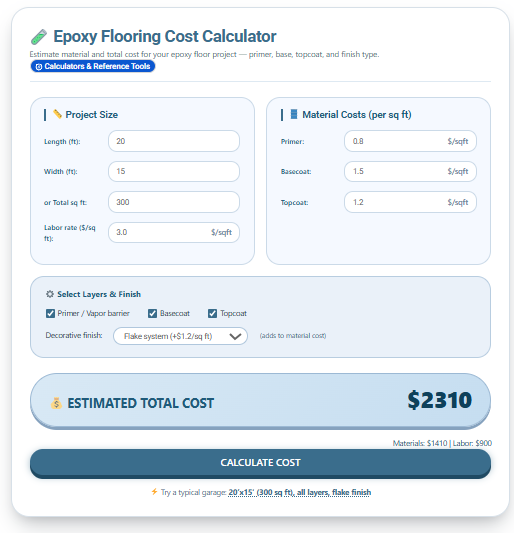
Better news: You do not need to guess. Use our Epoxy Flooring Cost Calculator to get a customized estimate in 60 seconds.
2. Epoxy Cost Per Square Foot: Complete Breakdown
Let us start with the bottom-line numbers, then explain what each tier includes.
Basic Epoxy (Garage Grade): $3–$7 per sq ft
What you get:
- Primer coat (sometimes omitted – be careful)
- Single coat of standard epoxy
- Basic topcoat (clear sealer)
- Solid color (gray, tan, beige)
Best for: Home garages, workshops, storage rooms, utility spaces.
Durability: 5-10 years with normal use.
Appearance: Functional, not decorative. Solid color, no texture, minimal gloss.
Example 2-car garage (400 sq ft): $1,200 – $2,800 total.
Caveat: At the low end ($3/sq ft), the contractor is likely skipping primer or using very thin material. Pay attention to what is included.
Standard Epoxy (Residential Grade): $5–$12 per sq ft
What you get:
- Primer/vapor barrier (essential for concrete)
- High-build basecoat (thicker than basic)
- Protective topcoat with UV stabilizers
- Decorative option: flake chips or light texture
Best for: Basements, living rooms, showrooms, home gyms, man caves.
Durability: 10-20 years.
Appearance: Attractive. Flake chips add color, hide imperfections, and provide slip resistance.
Example 500 sq ft basement: $2,500 – $6,000 total.
Why the wide range? Flake density is the variable. Light flake (sparse chips) costs less. Full broadcast (completely covered in chips) costs more.
Premium Epoxy (Commercial Grade): $8–$20+ per sq ft
What you get:
- All three layers (primer, base, topcoat) at maximum thickness
- Metallic epoxy or quartz aggregate finish
- High-performance topcoat (chemical-resistant, anti-static, or UV-stable)
- Professional surface preparation (grinding, patching, moisture testing)
Best for: Restaurants, retail stores, medical offices, auto dealerships, industrial facilities.
Durability: 20+ years, often with warranties.
Appearance: Stunning. Metallic epoxy creates a 3D, marbled, liquid-metal look. Quartz provides a textured, high-end terrazzo appearance.
Example 1,000 sq ft retail space: $8,000 – $20,000+ total.
Note at the high end: $20+/sq ft projects include extensive floor preparation (repairing cracks, leveling uneven concrete) and custom colors.
3. Total Project Cost by Room Size (Real Examples)
Here are real-world total costs for common project sizes. These assume standard epoxy ($8/sq ft average) with flake finish.
| Room/Area | Typical Size (sq ft) | Material Cost | Labor Cost | Total Cost |
|---|---|---|---|---|
| Single-car garage | 200 sq ft (12′ x 16′) | $800 – $1,200 | $600 – $1,000 | $1,400 – $2,200 |
| Two-car garage | 400 sq ft (20′ x 20′) | $1,600 – $2,400 | $1,200 – $2,000 | $2,800 – $4,400 |
| Three-car garage | 600 sq ft (30′ x 20′) | $2,400 – $3,600 | $1,800 – $3,000 | $4,200 – $6,600 |
| Basement (one room) | 500 sq ft | $2,000 – $3,000 | $1,500 – $2,500 | $3,500 – $5,500 |
| Basement (full) | 1,000 sq ft | $4,000 – $6,000 | $3,000 – $5,000 | $7,000 – $11,000 |
| Small retail store | 1,500 sq ft | $6,000 – $9,000 | $4,500 – $7,500 | $10,500 – $16,500 |
| Warehouse (section) | 5,000 sq ft | $20,000 – $30,000 | $10,000 – $20,000 | $30,000 – $50,000 |
Important: These are estimates. Use our Epoxy Flooring Cost Calculator with your exact dimensions for a personalized quote.
4. Material Costs: Primer, Basecoat, Topcoat Explained
Epoxy flooring is not one product. It is a system of layers. Each layer has a different cost and purpose.
Primer (Vapor Barrier): $0.50 – $1.50 per sq ft
Purpose: Seals concrete, blocks moisture vapor, ensures adhesion.
Why you need it: Concrete is porous. Moisture rises from the ground through the concrete. Without a primer, that moisture pushes your epoxy off the floor (called “blistering” or “peeling”).
Can you skip it? Only if your concrete is above-grade (like a second-floor condo) and you have confirmed zero moisture. For garages and basements, never skip primer.
Cost impact: Adding primer adds $0.50-$1.50/sq ft but prevents failure. Worth every penny.
Basecoat (The Epoxy Layer): $1.50 – $5.00 per sq ft
Purpose: This is the actual epoxy floor. It provides thickness, durability, and color.
Why price varies: Higher-priced basecoats are thicker (more material), have higher solids content (less solvent, stronger finish), and include better resins.
Cheap basecoat ($1.50/sq ft): Water-based epoxy, thin application (5-8 mils). Fine for light traffic.
Premium basecoat ($5.00/sq ft): 100% solids epoxy, thick application (15-20 mils). Withstands heavy vehicles, hot tires, chemical spills.
Cost impact: The basecoat is your largest material expense. Do not cheap out if you park cars or use heavy equipment.
Topcoat (Clear Sealer): $0.80 – $2.00 per sq ft
Purpose: Protects the basecoat from UV damage, chemicals, and abrasion. Adds gloss.
Why you need it: Epoxy yellows in direct sunlight. A UV-stable topcoat prevents this. Also, the topcoat is what you clean and maintain.
Two types:
- Standard topcoat: Good for garages (no direct sun) and basements.
- UV-stable topcoat: Essential for showrooms, patios, or any area with windows.
Cost impact: Adding a quality topcoat adds 20-30% to material costs but doubles the lifespan of your floor.
5. Labor Costs: DIY vs. Professional Installation
This is where you save the most money – or make the most expensive mistake.
DIY Installation: $0 labor (but buy/rent tools)
Tool costs for DIY:
- Floor grinder rental: $100-$200/day
- Diamond grinding pads: $50-$100
- Squeegee and spike roller: $50
- Mixing drill and paddle: $60
- Painter’s tape and supplies: $30
Total tool investment: $300-$500 (one-time, reusable)
DIY skill level required: Medium-high. Epoxy application is not like painting a wall. You have limited working time (pot life), and mistakes are permanent.
When DIY makes sense:
- Small garage (under 300 sq ft)
- You have experience with concrete coatings
- You can take 3-4 days for the project (prep, dry time between coats)
- You are comfortable mixing chemicals
When to avoid DIY:
- Large areas (over 500 sq ft)
- Basements with moisture issues
- Any project requiring metallic epoxy (expert application needed)
- You have never worked with two-part epoxies before
Professional Installation: $2 – $8 per sq ft
What you pay for:
- Surface preparation (grinding, patching, moisture testing)
- Material mixing and application expertise
- Proper safety equipment
- Warranty (typically 5-15 years)
- Speed (professionals finish in 1-2 days)
Regional labor rates (per sq ft):
| Region | Low-End (Basic) | High-End (Premium) |
|---|---|---|
| Rural South/Midwest | $2.00 – $2.50 | $4.00 – $5.00 |
| Suburban areas | $2.50 – $3.50 | $5.00 – $6.00 |
| Major metro (Atlanta, Dallas, Phoenix) | $3.00 – $4.00 | $6.00 – $7.00 |
| Coastal metro (LA, NYC, Seattle, Boston) | $4.00 – $5.00 | $7.00 – $8.00 |
Getting multiple quotes: Always get 3 quotes. Ask each contractor exactly which layers (primer, base, topcoat) and what thickness (mils) they provide. Compare apples to apples.
6. Finish Options: How Flakes, Metallic, and Quartz Affect Price
The finish is what you see. It is also a major cost variable.
Solid Color (No Additives): $0 extra (base price)
Look: Uniform color, semi-gloss to high-gloss.
Pros: Cheapest, easiest to apply.
Cons: Shows every imperfection in the concrete. No slip resistance.
Best for: Utility rooms, workshops, commercial kitchens.
Flake (Vinyl Chips): +$0.50 – $2.00 per sq ft
Look: Colored chips embedded in the epoxy. Light, medium, or full coverage.
Pros: Hides imperfections, provides slip resistance, decorative.
Cons: Texture can be rough on bare feet (use light flake for basements).
Best for: Garages (excellent for hiding oil stains), showrooms, man caves.
Pricing tiers:
- Light flake (10-20% coverage): +$0.50/sq ft
- Medium flake (40-60% coverage): +$1.00/sq ft
- Full broadcast (100% coverage): +$2.00/sq ft
Metallic Epoxy: +$2.00 – $5.00 per sq ft
Look: 3D, marbled, liquid-metal appearance. Can mimic water, marble, or abstract art.
Pros: Stunning high-end look. Unique (no two floors look identical).
Cons: Requires expert application. Shows dust and footprints.
Best for: Retail stores, restaurants, luxury garages, medical offices.
Warning: Do not DIY metallic epoxy. The application technique (pouring, swirling, torching) takes years to master. Hire a specialist.
Quartz Aggregate: +$3.00 – $6.00 per sq ft
Look: Textured, speckled floor with crushed quartz crystals.
Pros: Extremely durable. Excellent slip resistance (even wet). Hides everything.
Cons: Expensive. Rough texture (not for barefoot areas).
Best for: Commercial kitchens, locker rooms, pool decks, auto shops.
7. Hidden Costs Most Guides Don’t Mention
These costs surprise many homeowners. Budget for them.
Concrete Repair: $1 – $3 per sq ft
- Cracks wider than 1/8″ need filling.
- Spalled (flaking) concrete needs patching.
- Uneven slabs need grinding or self-leveler.
Moisture Testing: $200 – $500
- Required for basements and slab-on-grade floors.
- A calcium chloride test takes 72 hours. Skipping it risks floor failure.
Baseboard Removal/Replacement: $1 – $2 per linear foot
- Epoxy should go under baseboards for a clean look.
- Removing and reinstalling baseboards adds labor.
Disposal of Old Flooring: $100 – $300
- If removing old tile, paint, or carpet, disposal fees apply.
Moving Furniture/Equipment: $200 – $800
- Empty garages and basements before the crew arrives.
- Some contractors charge extra if they have to move heavy items.
Total hidden costs: Add 10-20% to your estimated budget for contingencies.
8. Regional Price Differences (USA, Canada, UK, Australia)
Epoxy flooring costs vary significantly by country due to material availability and labor rates.
| Country | Basic Epoxy (DIY) | Standard (Installed) | Premium (Installed) |
|---|---|---|---|
| United States | $3-5/sq ft | $7-12/sq ft | $12-20+/sq ft |
| Canada | $4-7 CAD/sq ft | $9-15 CAD/sq ft | $15-25 CAD/sq ft |
| United Kingdom | £25-35/sq m | £50-90/sq m | £90-150/sq m |
| Australia | $35-55 AUD/sq m | $70-120 AUD/sq m | $120-200 AUD/sq m |
Conversion notes:
- 1 sq meter = 10.76 sq ft
- To convert $/sq ft to $/sq m, multiply by 10.76
- Example: $8/sq ft × 10.76 = $86/sq m
9. How to Use the Epoxy Flooring Cost Calculator
Now that you understand all the components, here is how to use our Epoxy Flooring Cost Calculator effectively.
Step 1: Measure your space
- For rectangles: Length × Width = Square feet
- For L-shapes: Divide into two rectangles, calculate each, add together
- Include closets, alcoves, and any area to be coated
Step 2: Enter project size
- Input total square footage
- Or enter length and width (calculator does the math)
Step 3: Select your layers
- Check boxes for Primer, Basecoat, Topcoat
- Most garages and basements need all three
Step 4: Choose your finish
- Solid color (cheapest)
- Flake (adds $0.50-$2.00/sq ft)
- Metallic (adds $2.00-$5.00/sq ft)
Step 5: Set your labor rate
- DIY: Set labor to $0 (but remember tool rental costs)
- Professional: Use $2-$8/sq ft based on your region
Step 6: Click calculate
- The calculator shows material cost, labor cost, and total
- Adjust any variable to see how it affects your budget
Step 7: Use the example
- Click “Try a typical garage” (20′ × 15′ = 300 sq ft, all layers, flake finish)
- See a complete sample estimate to verify you are using the tool correctly
10. Frequently Asked Questions
Is epoxy flooring cheaper than tile or hardwood?
Yes. Epoxy typically costs $3-12/sq ft installed. Ceramic tile is $10-25/sq ft. Hardwood is $8-22/sq ft. Epoxy is one of the most affordable durable flooring options.
How long does epoxy flooring last?
- Basic epoxy (thin, no primer): 3-5 years
- Standard epoxy (primer + base + topcoat): 10-20 years
- Premium epoxy (thick, commercial grade): 20+ years
Can I install epoxy over old epoxy?
Yes, but the old epoxy must be sound (not peeling). You need to rough up the surface with a grinder so the new epoxy adheres. This is called “scuff sanding.”
Why do some contractors quote $2/sq ft?
They are likely skipping primer, using thin material, or offering a single coat of epoxy with no topcoat. Ask for a detailed breakdown. Cheap quotes often lead to floor failure within 1-2 years.
Does epoxy increase home value?
Yes, especially in garages and basements. A professionally installed epoxy floor can add $2,000-$5,000 to resale value and makes the home show better.
What is the cheapest way to get an epoxy floor?
DIY basic epoxy (solid color, no primer) on a small garage. Cost: approximately $2-3/sq ft for materials. However, skipping primer risks failure. The better value is DIY with primer for $4-5/sq ft.
How do I get an accurate quote from a contractor?
Use our calculator first to know what the materials should cost. Then ask contractors for a line-item quote showing:
- Primer cost per sq ft
- Basecoat cost per sq ft (and thickness in mils)
- Topcoat cost per sq ft
- Labor rate per sq ft
- Warranty in writing
If a contractor refuses to provide these details, hire someone else.
11. Conclusion: Get Your Exact Price in 2 Minutes
You now have all the information needed to budget accurately for your epoxy flooring project. The range is wide – from $3/sq ft for a basic DIY garage floor to $20+/sq ft for premium metallic epoxy with professional installation – but you know exactly what drives those differences.
Your action plan:
- Measure your space (length × width for rectangles, divide L-shapes)
- Use our Epoxy Flooring Cost Calculator to get an instant estimate
- Adjust the variables (layers, finish, labor) to see how each affects your total
- Get 3 contractor quotes using the detailed breakdown from our calculator as a benchmark
- Budget 10-20% extra for hidden costs (concrete repair, moisture testing, moving furniture)
Epoxy flooring is an investment. A properly installed floor lasts 10-20 years. Spending a little more upfront on quality materials and professional installation pays off in longevity and appearance.
Now open the calculator and get your personalized estimate.